There are films that end when the credits roll, and there are films that linger—quietly, persistently—long after the screen fades to black. Edward Scissorhands (1990) belongs firmly to the latter. More than three decades later, Edward remains one of cinema’s most haunting figures: a creation born unfinished, armed with blades instead of hands, and cursed with a heart far gentler than the world ever deserved.
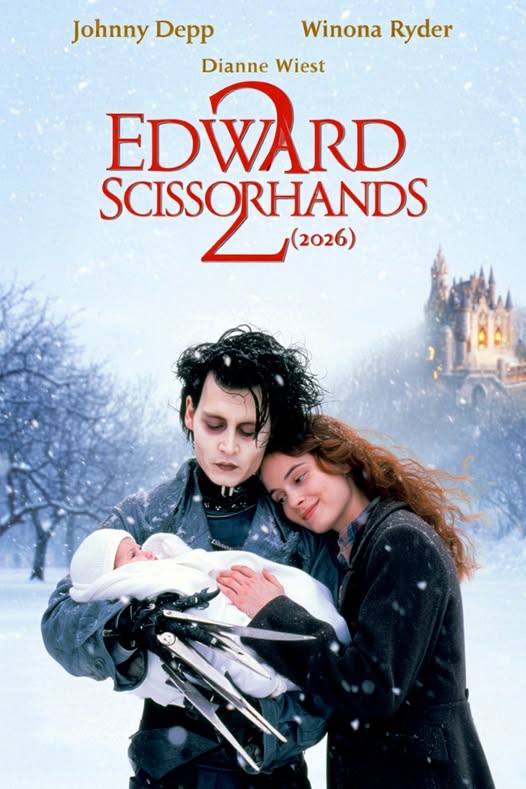
In the collective imagination of audiences, Edward’s story has never truly concluded. And so emerges the idea of Edward Scissorhands 2 (2026)—not as a confirmed sequel, but as a hypothetical continuation shaped by nostalgia, longing, and unanswered questions.

This imagined sequel does not begin with spectacle. There are no explosions, no dramatic reveals. Instead, it opens in silence, returning us to the snow-covered castle perched above the town. Time has passed, yet Edward (Johnny Depp) remains unchanged—frozen not only by winter, but by memory. His scissorhands still glint under pale moonlight, sharp and beautiful, yet forever incapable of offering the simplest human gesture: a touch.
Below the hill, the town has evolved. The pastel suburbs of the past have transformed into a modern world obsessed with perfection—curated appearances, digital admiration, and flawless surfaces. Ironically, this new society is even less forgiving of imperfection than the one that once rejected Edward. In such a world, his existence feels not merely tragic, but radically out of place.

The stillness shatters when a young artist ascends the hill, drawn by whispers of a forgotten legend. Unlike those before, this visitor does not seek fear or fascination, but understanding. Through this encounter, Edward is reintroduced—not as a myth, not as a monster, but as a living soul shaped by isolation. Art once again becomes his language, carving beauty out of coldness, meaning out of solitude.
Running parallel to this rediscovery is the return of Kim Boggs (Winona Ryder). Now older, reflective, and carrying a lifetime of quiet regret, Kim confronts the memory of a love that never found its proper ending. Their reunion is understated, restrained by time and circumstance. It is not a rekindling of romance, but something far more poignant—a shared acknowledgment of what was lost, and what could never be.

If Edward Scissorhands 2 were to exist, it would not aim to surpass the original. Instead, it would deepen its emotional resonance. Tim Burton’s signature aesthetic—gothic yet tender, melancholic yet whimsical—would once again frame a modern fairytale where snow falls like memory and silence speaks louder than words. Danny Elfman’s music, imagined here as ever-present, would drift through scenes like a heartbeat echoing in empty halls.
At its core, the story remains timeless. A society that worships beauty often fears difference. Edward’s tragedy was never his scissorhands—it was humanity’s inability to look beyond them. In an era dominated by curated identities and superficial connection, his quiet suffering feels more relevant than ever. He becomes a mirror held up to a world that has learned how to admire appearances, but forgotten how to practice compassion.

It is important to state clearly: Edward Scissorhands 2 (2026) is not an actual film project. There has been no confirmation from Tim Burton, Johnny Depp, or any studio regarding a sequel. Yet the very fact that this imagined continuation resonates so deeply speaks volumes about the original film’s enduring power.
Some characters do not need sequels to survive. They endure because they represent something eternal—our fear of being different, our longing to belong, and our hope that kindness might still find a place in a fractured world. Edward lives on in that quiet space between memory and emotion, where snow continues to fall, blades continue to shine, and a fragile heart continues to beat—still waiting, still hoping, still loving.
And perhaps that is where Edward belongs most: not on a release schedule, not in a franchise lineup, but in the collective soul of cinema itself.